Retire in Spain: Your Guide to a Sunny Retirement on the Costa del Sol
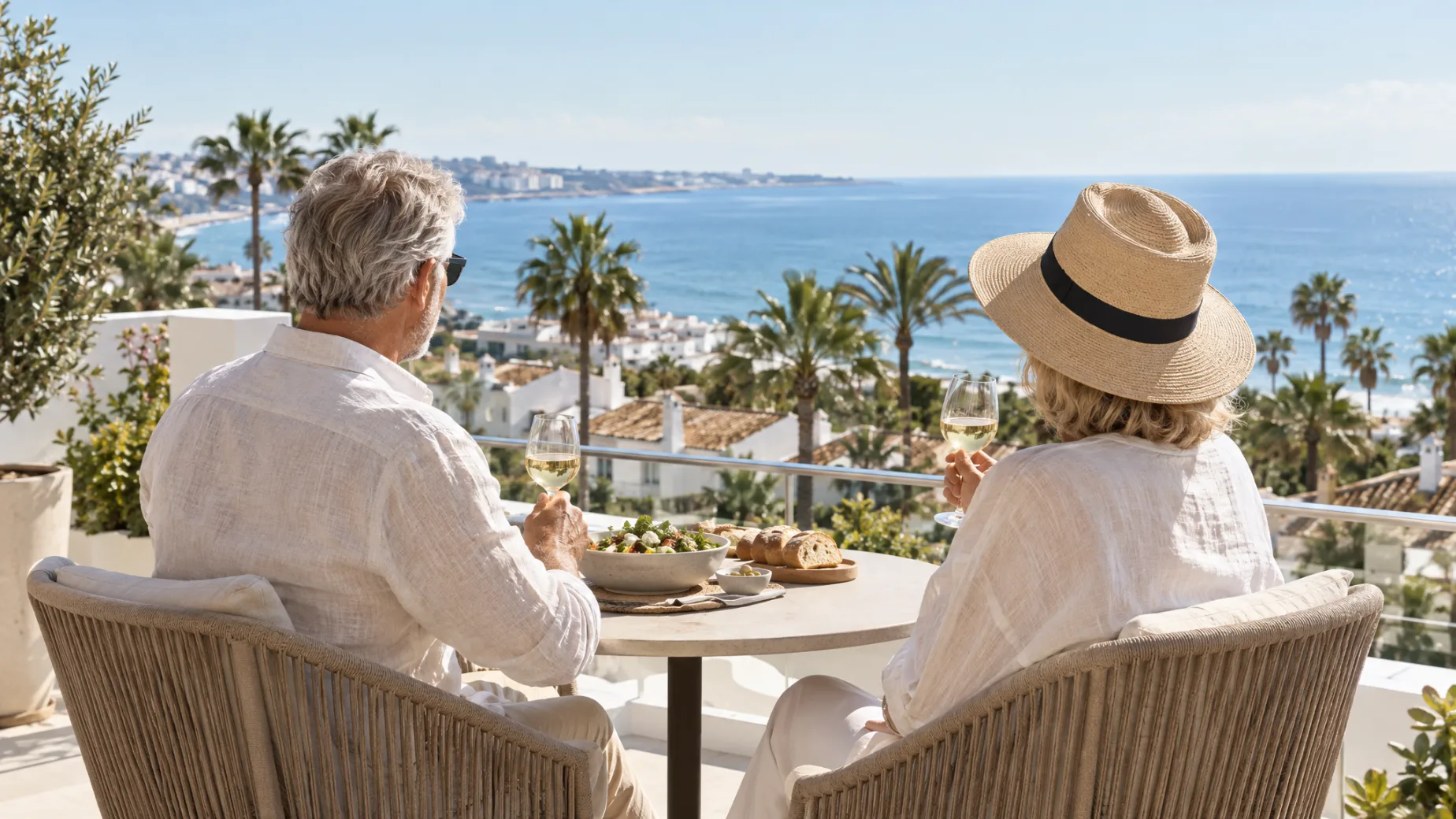
Breakfast on the terrace in January, a walk along the promenade before lunch, an afternoon on the golf course and dinner with friends in the old town. For many people, to retire in Spain means finally living the life they have enjoyed on holiday for years, with more sun, more time and a pace that leaves room for the things that matter.
We moved to Estepona from Germany ourselves and went through the paperwork of settling here: the NIE, the residence registration, the padrón, the first year of getting to know the town. Since 2019 we have worked with all the developers from Sotogrande to Marbella, and I look after every buyer personally. This guide brings together everything that matters when you plan your retirement here: the life, the place, the visa, healthcare, pensions, tax and the home that makes it all easy.
Retire in Spain: what a year of retirement on the Costa del Sol looks like
Retirement on the Costa del Sol is a life lived outdoors, in every season of the year. The climate is the first thing people notice, and it shapes everything else: when you walk, when you eat, how often you see friends and how much of each day you spend in the sun.
Winter is the season that surprises newcomers most. The days are mild and bright, lunch is taken outside in the sunshine, and the golf courses are at their greenest. Spring brings flowers to the old town, festivals in the villages and the first swims for the brave. Summer is for early mornings on the beach, long siestas in the shade and late dinners when the air has cooled. And autumn, with warm sea water and quiet beaches, is for many the most beautiful time of all.
Daily life settles into a gentle rhythm. A coffee at the same café each morning, where the waiter starts your order as you walk in. The market for fresh fish, fruit and vegetables. A walk along the coastal path, an afternoon of padel, tennis or golf, a Spanish lesson, a visit from the grandchildren. The Spanish take their evenings seriously, and after a while so do you: a table outside, friends around it and nowhere else to be.
There is also a strong community to join. The western Costa del Sol has a long tradition of welcoming people from across Europe and beyond, alongside a warm Spanish community, so you will find clubs, walking groups, volunteering, choirs and language exchanges in English as well as Spanish. With so much going on, the calendar fills up quickly, and the harder question soon becomes which invitation to accept.
Why Estepona is a wonderful place to retire in Spain
Estepona is a real Spanish town that lives all year, and it offers exactly what a good retirement needs: everything within reach. With almost 80,000 residents, a restored old town full of flowers, 21 kilometres of coastline and a long seafront promenade, it is large enough for every service and small enough to feel like home.
The things that matter most in retirement are close at hand. Doctors, pharmacies and supermarkets are in every neighbourhood, and according to the town hall Estepona has funded its own hospital. The town has almost completed a coastal path of more than 21 kilometres for walking and cycling, and it is investing around €27 million in its 2026 budget, while property tax for registered households is falling. Its population grew from around 67,000 in 2016 to almost 80,000 in 2025, a sign of how many people choose it as their home.
Getting around is easy. Málaga airport is 84 kilometres away, with flights to most of Europe, and Gibraltar is 45 kilometres to the west. Marbella is half an hour up the coast for an evening out, and Sotogrande, with its marina and polo, is a short drive in the other direction.
The cost of settling in is concrete. On our own analysis, long-term rents in Estepona averaged €21 per square metre a month in August 2026, and new developments were asking €5,145 per square metre on our survey of 18 September 2026, against €7,491 in our Marbella market area. For the same budget, you get more space in Estepona, in a town that is as lively in February as it is in July.

Where in Estepona to live: centre, beach or golf
Each part of Estepona offers a different kind of retirement, and new homes are being built in all of them. On our survey of 21 September 2026, these neighbourhoods had the most New Build homes on offer:
- Estepona Pueblo, the centre: 97 units in 15 projects, within walking distance of the old town, the market, the promenade and the harbour. Ideal if you want to live without a car.
- Benamara–Atalaya, in the east: 253 units in 38 projects, close to beaches and several golf courses, with quick access to Marbella.
- Selwo, on the New Golden Mile: 126 units in 15 projects, green and quiet, with beaches a short drive away.
- Playa Bahía Dorada and Costa Natura, in the west: 174 and 131 units, calm developments with pools and gardens close to the beach.
- Punta Plata, on the New Golden Mile: 54 units in 5 projects, right by the beach.
For many retirees the centre is the natural first choice, because everything is on foot: the doctor, the pharmacy, the café and the beach. Others prefer the space and quiet of the developments in the east and west, with gardens, pools and the golf course a few minutes away. The best way to decide is to spend a few days in each, and I am happy to show you around so you get a feeling for the whole town before you choose.
The visa to retire in Spain: the non-lucrative route
If you are from outside the EU, the non-lucrative visa is the retirement visa: residence in Spain on your own income, without working here. It is set out in Articles 61 to 64 of Spain's Immigration Regulation, which has applied in its current form since 20 May 2025.
The application is made at the Spanish consulate responsible for where you live, and the visa and residence permit are one procedure. Once the visa is granted, you travel to Spain, and your one-year permit starts on the day you arrive. Within a month you apply for your residence card, the TIE, at the police office for your area. Our detailed guide to the Spain non-lucrative visa sets out every document and step.
If you are an EU citizen, you do not need a visa at all. You simply register as a resident once you have lived here for three months, with proof of health cover and sufficient means. For British retirees, the country guide on moving to Spain from the UK covers the post-Brexit details, and Americans will find theirs in our guide to moving to Spain from the USA.
How much income you need to retire in Spain
For the non-lucrative visa, the main applicant needs €2,400 a month in 2026, and a couple €3,000. The figures are tied to IPREM, Spain's public income indicator, which has been €600 a month since 2023: 400% for the applicant and 100% for each family member.
| Household | Per month | First year |
|---|---|---|
| Retiree alone | €2,400 | €28,800 |
| Retired couple | €3,000 | €36,000 |
| Couple plus one dependant | €3,600 | €43,200 |
Pensions count as regular income, whether state, company or private, and so do annuities, dividends, interest and rent from property you own. Savings count as funds, as long as they are available to you. You can combine a pension with savings to reach the figure comfortably. At renewal, the figure covers the two years of the new permit.
These are minimum figures for the visa, not a budget for your life here. The monthly cost of living depends on your home, your habits and how often you travel, and our guide to the cost of living on the Costa del Sol sets out a realistic budget line by line.

Healthcare when you retire in Spain
Spain has excellent healthcare, and there are clear routes into it for retirees from the UK, the US and elsewhere. Which route applies to you depends on where your pension comes from and where you are in the residence process.
Private health insurance for the visa
For the non-lucrative visa you show health insurance with an insurer authorised to operate in Spain, covering all the risks covered by the Spanish public health system, and you keep that cover throughout the permit. Several Spanish insurers offer policies designed for residence applications. Private healthcare on the Costa del Sol is of a high standard, with modern clinics in Estepona, Marbella and along the coast and many English-speaking doctors.
British pensioners: the S1 form
If you receive the UK State Pension, you can apply to the NHS Business Services Authority for an S1 form. Once it is registered with the Spanish social security office, the INSS, which can also be done online, you have access to Spanish public healthcare on the same terms as Spanish residents, with the UK covering the cost. It is one of the most valuable things to arrange before you move.
Americans: Medicare stays at home
Medicare usually does not cover healthcare outside the United States, so American retirees in Spain rely on Spanish private health insurance, which is also what the visa requires. The social security agreement between the two countries, in force since 1988, coordinates pension contributions but does not extend Medicare to Spain.
Joining the public system later: the convenio especial
After a year of registration on the padrón, residents in Andalusia who have no other access can join the public health system through the convenio especial, a monthly contribution of €60 under 65 and €157 from 65. Medicines are paid in full under this scheme, but consultations and hospital care are covered, and the scheme can be combined with a private policy.
Your pension in Spain: paid, protected and increased
Your pension follows you to Spain, and for British retirees the annual increases continue too. Pensions are paid into your bank account wherever you live, and a Spanish account keeps the monthly budget simple.
The UK State Pension is increased every year for people living in the European Economic Area, which includes Spain, so moving here does not freeze it. Company and private pensions are paid as usual, and a transfer service or a Spanish account in euros keeps the currency side calm. US Social Security can be paid to you in Spain, and the totalization agreement between the two countries helps if you have worked in both.
If you have lived and worked in several countries, it is worth asking each pension provider how they pay abroad and what they need from you each year, such as a certificate that you are still living. Setting this up once before the move means your income arrives smoothly from the very first month.
A Spanish bank account is the practical centre of your new life. Utility bills, the community fees of your development, property tax and your phone contract are all paid by direct debit, so once your pension arrives each month, the household runs by itself. Opening the account is one of the first things to do after your NIE, and you will need little more than your passport, your NIE and proof of your address.
Tax when you retire in Spain: simple with good advice
Living in Spain for more than 183 days a year makes you tax resident here, and a double taxation treaty decides which country taxes each pension. Income is not taxed twice, and with one good adviser the system is straightforward.
Under the treaty between the UK and Spain, private pensions and the UK State Pension are taxed in Spain once you are resident here, while UK government service pensions, such as those of civil servants, teachers or the armed forces, remain taxable in the UK, though they are taken into account for your Spanish tax rate. HMRC provides a form, Spain-Individual, to apply the treaty so your pension is paid without UK tax where it belongs in Spain.
Americans keep filing US tax returns wherever they live, and the treaty between the United States and Spain, with its protocol in force since 2019, decides how the two systems fit together. As a Spanish resident you may also need to declare assets held abroad above €50,000 per category on form 720, between 1 January and 31 March, which is a declaration rather than a tax.
There is good news for your family as well. Andalusia gives spouses, children and grandchildren a 99% reduction on inheritance tax, and the EU Succession Regulation lets you choose the law of your nationality for your will. A short Spanish will, coordinated with the one you have at home, makes things easy for those who come after you.
A home for the years ahead: why New Builds suit retirement
The best retirement home is one that stays easy to live in for many years, and a New Build is designed for exactly that. Modern developments on the Costa del Sol combine the things that matter more with every passing year: level access, lifts, low maintenance and everything close by.
- A lift to your floor, or a home on one level
- Level access from the garage to the front door and onto the terrace
- A walk-in shower and wide doorways
- Air conditioning and good insulation for comfort in summer and winter
- A covered terrace for shade in the afternoon
- A communal pool and gardens maintained by the community
- A guest bedroom for family and friends who come to visit
- Shops, doctors and a café within walking distance
New Builds also bring certainty. Payments during construction are protected by a bank guarantee or insurance in your name once the building licence is granted, and after handover the law provides warranties of ten years for the structure, three for habitability and one for finishing. In Estepona the price difference to a Resale is small: on our analysis, New Builds were only 2.9% above the Resale index in September 2026. Our guide to buying off-plan in Spain explains the protections in detail.
Buying off-plan also fits a retirement move beautifully. While your home is being built, you can rent in the area you have chosen, settle in, make friends and learn the town. When the keys arrive, you move into a home you picked from the plans, on the floor and with the view you wanted. The new developments in Estepona show the choice available today.
New developments in Estepona






How to retire in Spain, step by step
A move in retirement goes smoothly when the steps are taken in the right order. This is the sequence that works for retirees from outside the EU:
- Visit and choose your town: spend a few weeks on the coast, ideally in winter as well as summer.
- Check the income figure for your household against your pensions and savings, with a margin.
- See a tax adviser about pensions, savings and the timing of your move.
- Arrange healthcare: an S1 for UK State Pension recipients, and private insurance for the visa.
- Prepare the documents: bank letters, pension statements, criminal record and medical certificates, apostilles and translations.
- Apply at the consulate for your place of residence and collect your visa within a month of the decision.
- Arrive and register: TIE within a month, padrón at the town hall, a Spanish bank account.
- Find your home: rent while you look, or reserve a New Build and move in when it is ready.
For EU citizens the list is shorter: no visa and no consulate, just registration as a resident after three months, the padrón and the practical steps of settling in. Either way, the NIE number is needed for everything from a bank account to a property purchase, and our guide explains how to get it.
Your first year: from arrival to feeling at home
The first year is the one where Spain turns from a destination into home. This is how it can unfold:
- Month 1 TIE appointment, padrón registration, bank account and phone contract.
- Months 2–3 Doctor, pharmacy and health cover set up; S1 registered if you have one.
- Months 3–6 Spanish lessons, clubs, walking groups and the first friends.
- Months 6–9 Viewing homes or following the construction of your New Build.
- Months 10–12 Renewal application in the two months before your first permit ends.
By the end of the first year, the paperwork is behind you. Your renewal runs for two years, then two more, and after five years you can apply for long-term residence, which is no longer tied to your income. Spanish citizenship is possible after ten years for most nationalities, and after two for nationals of Ibero-American countries, the Philippines, Andorra, Equatorial Guinea and Portugal.
Driving, pets and the practical side of the move
The practical details of a retirement move are easy to arrange once you know the rules for your country. Two questions come up for almost everyone: the car and the dog.
Driving. A UK driving licence can be used for six months after you become resident, and it can be exchanged for a Spanish licence without a test, so it is worth doing within that period. An American licence works differently: there is no exchange agreement between Spain and the United States, so after six months of residence you take the Spanish theory and practical tests. An international driving permit alongside your US licence is useful for the first months. In the centre of Estepona you can manage well without a car, because the old town, the promenade, the market and the doctor are all on foot.
Pets. Dogs and cats travel to Spain with a microchip, a rabies vaccination given at least 21 days before travel and a health certificate. From the UK this is the Animal Health Certificate, used within ten days of issue for entry; the UK pet passport is no longer valid for travel into the EU. From the United States, a USDA-accredited vet issues the EU health certificate, APHIS endorses it, and you enter Spain within ten days. Once you live here, a Spanish vet can issue an EU pet passport, which makes later trips around Europe simple. The coast is very dog-friendly, with dog beaches and long walks along the coastal path.
Family visits and travel from your new home
Living on the Costa del Sol keeps you close to family and opens up the rest of Europe. Málaga airport, 84 kilometres from Estepona, has flights to cities across Europe, and Gibraltar airport is 45 kilometres away, so visits in both directions are easy to arrange.
For many families, the retirement home becomes the new holiday home for everyone: grandchildren in the summer, friends in the winter, long weekends for the rest of the family in between. A guest bedroom, a terrace big enough for a family lunch and a communal pool turn those visits into the highlights of the year.
And the travelling does not stop at the airport. With your residence card you can travel within the Schengen area, and from Estepona the great cities of Andalusia are within easy reach: Ronda in the mountains, Seville, Granada with the Alhambra, Córdoba and the white villages in between. Retirement here is not only a quieter life, but also the chance to discover a whole new part of Europe at your own pace.
Living well in Spain in the years ahead
A good retirement in Spain is built on three things: a home that stays easy, a town with everything close by and a circle of friends. Estepona offers all three, and the years ahead can be some of the best of your life.
Stay active and the coast rewards you: the coastal path for morning walks, the sea for swimming, the golf courses and padel courts, and the mountains of the Sierra Bermeja for gentle hiking. Learn some Spanish, even a little, and doors open everywhere, from the market to the town hall. Join a club or a volunteer group, and the community quickly becomes your own.
The Spanish calendar adds colour to every month: the processions of Holy Week in spring, the summer fair with music and dancing, open-air concerts on warm evenings and the lights and markets of Christmas in the old town. Each celebration is a chance to meet your neighbours, and after a year or two you will find that you are no longer watching the festivities as a visitor but taking part in them as a local.
And plan the practical side once, so it runs by itself: a will in Spain, powers of attorney for the family, direct debits for the bills and a trusted local adviser for tax. Then there is nothing left to do but enjoy the sunshine.
Retire in Spain: your perfect day first, then the town
Start with the life you want, then the town, then the paperwork. Picture a perfect ordinary day in retirement: where you have your coffee, how you spend the afternoon, who you see in the evening. Then come to the Costa del Sol for a few weeks, ideally in the winter months, and see how it feels to live that day here.
From there, the steps follow a clear path: the income figure and the tax conversation, healthcare, the consulate and the move. If you decide to retire in Spain, Estepona gives you a real town, a beautiful coast, all the services you need and the largest choice of new homes between Sotogrande and Marbella. I would be delighted to show it to you.
Frequently asked questions
Can I retire in Spain as a non-EU citizen?
Yes. To retire in Spain from outside the EU, the usual route is the non-lucrative visa, a residence permit for people who live on their own income without working in Spain. It starts with one year and is then renewed for two years at a time.
How much income do I need to retire in Spain?
For the non-lucrative visa in 2026, the main applicant needs €2,400 a month, which is €28,800 for the first year, and each family member adds €600 a month. The figures are 400% and 100% of IPREM, which has been €600 a month since 2023.
Do I get healthcare in Spain as a British pensioner?
UK State Pension recipients can apply for an S1 form, which gives access to Spanish public healthcare once it is registered with the Spanish social security office. For the visa itself you also show health insurance with an insurer authorised in Spain.
Does Medicare work in Spain?
Medicare usually does not cover healthcare outside the United States, so American retirees in Spain rely on Spanish private health insurance, which is also what the visa requires.
Will my State Pension still rise if I live in Spain?
Yes. The UK State Pension is increased every year for people living in countries of the European Economic Area, which includes Spain.
Where is my pension taxed if I retire in Spain?
Once you live in Spain for more than 183 days a year you are tax resident here. Under the UK–Spain treaty, private pensions and the State Pension are taxed in Spain, while UK government service pensions stay taxable in the UK. Americans also keep filing US returns.
Is the public healthcare system open to retirees without an S1?
After a year of registration on the padrón, residents in Andalusia can join the public system through the convenio especial, at €60 a month under 65 and €157 a month from 65.
Where is the best place to retire in Spain?
That depends on the life you want. On the Costa del Sol, Estepona combines a year-round town of almost 80,000 residents, a restored old town, 21 kilometres of coast and its own hospital with the largest choice of new homes between Sotogrande and Marbella.
Should I buy or rent when I retire in Spain?
Both work. Buying off-plan lets you rent in your chosen area while your new home is being built, so you settle in first and move into a home designed for the years ahead, with a lift, level access and low running costs.
Can I become a permanent resident?
Yes. After five years of legal residence you can apply for long-term residence, which is no longer tied to your income. Spanish citizenship is possible after ten years for most nationalities.
Sources & official links
- BOE – Royal Decree 1155/2024, Immigration Regulation, Articles 61 to 64 (checked 21.09.2026)
- GOV.UK – Living in Spain (checked 19.09.2026)
- GOV.UK – Healthcare for UK nationals living in Spain (checked 19.09.2026)
- NHSBSA – Applying for healthcare cover for living abroad (checked 19.09.2026)
- Junta de Andalucía – Convenio especial for healthcare (checked 19.09.2026)
- GOV.UK – Countries where the State Pension increases every year (checked 19.09.2026)
- Agencia Tributaria – Tax information for residents with income from the United Kingdom (checked 19.09.2026)
- Medicare – Travel outside the U.S. (checked 20.09.2026)
- Social Security Administration – Totalization agreement with Spain (checked 20.09.2026)
- Ayuntamiento de Estepona – 2026 budget (checked 21.09.2026)