Spain Non-Lucrative Visa: Your Guide to Living in Spain in 2026

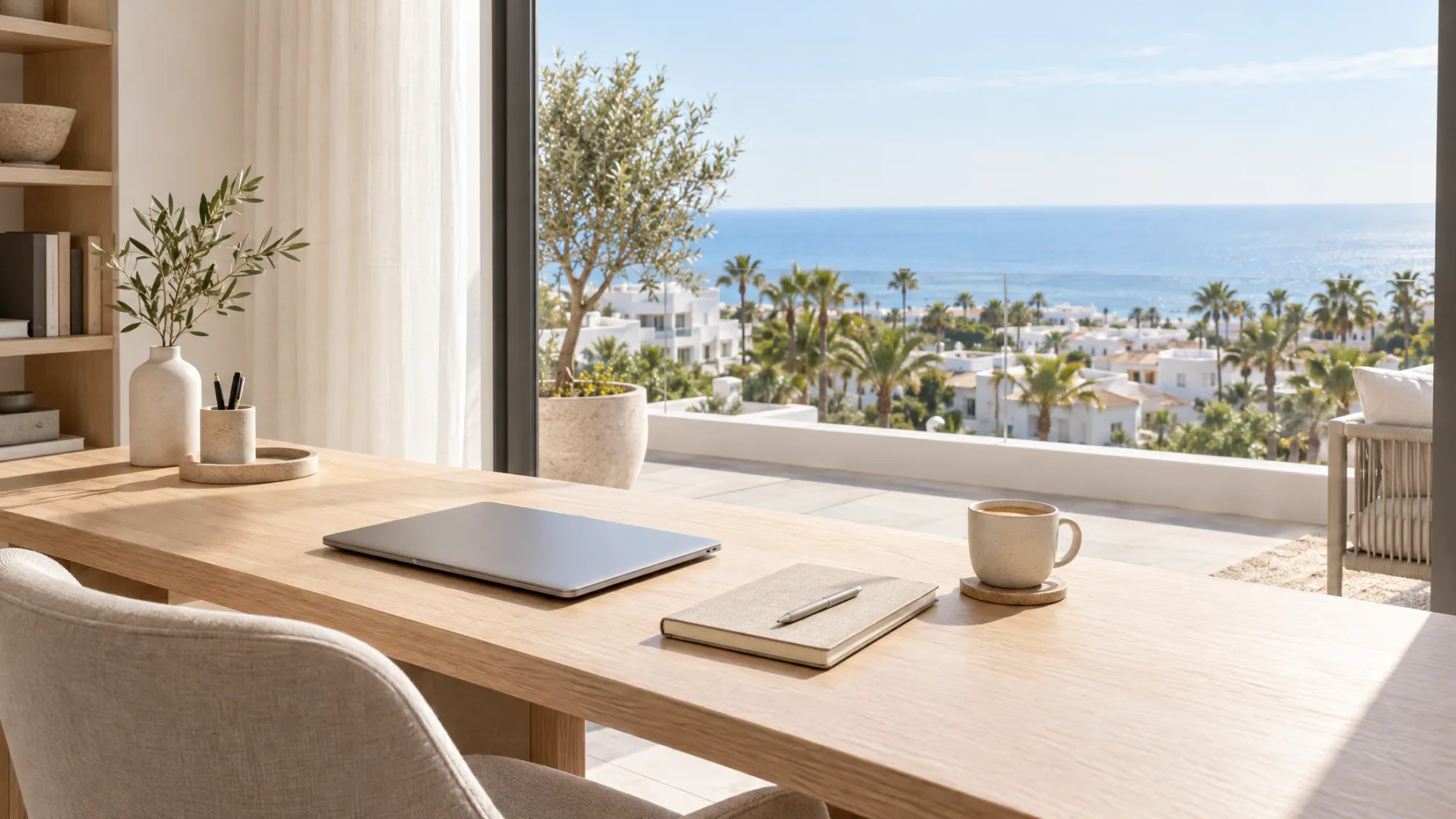
Morning coffee on a terrace above the sea, a walk along the promenade before lunch, a winter that feels like spring. For many people from outside the EU, the Spain non-lucrative visa is the door to exactly that life. It lets you live here on your own income, a pension, savings, rent or investments, without needing a job in Spain and without investing a fixed sum.
We moved to Estepona from Germany ourselves and went through the residence paperwork that comes with settling here: the appointments, the padrón, the first year of learning how the town works. As EU citizens our route was simpler, but the offices, the town and the joy of arriving are the same. I look after every buyer personally, and this guide sets out the non-lucrative route from the regulation itself, with the Costa del Sol side added where it helps you plan.
What the Spain non-lucrative visa is, and who it suits
The Spain non-lucrative visa is residence for people who support themselves without working in Spain. In legal terms it is a temporary residence permit without work, residencia temporal no lucrativa, set out in Articles 61 to 64 of the Immigration Regulation, Royal Decree 1155/2024, which has applied since 20 May 2025.
It suits a wide range of people. Retirees from the United States, the United Kingdom, Canada or Australia who want to spend the second half of life in the sun. Early retirees who have sold a business or built up savings. Couples who live on rental income or investments and want a slower, warmer rhythm. Families with independent means who want their children to grow up bilingual by the sea.
What they have in common is that their income does not depend on working in Spain. That is the whole idea of the permit: Spain welcomes you as a resident, and you bring your own means with you. There is no investment requirement, no minimum property purchase and no language test for the first permit, which makes it one of the most accessible residence routes in Europe for people with a stable income.
If you are an EU citizen, you do not need it at all. You already have the right to live in Spain and simply register as a resident once you arrive.
Life on the non-lucrative visa: a year on the Costa del Sol
The non-lucrative visa gives you the one thing a holiday never does: time. You are not here for two weeks in August, you are here for the seasons, and the western Costa del Sol is at its best in the months most visitors never see.
Autumn brings warm sea water well into October and the first quiet weekends in the hills. Winter is mild and bright, the season for long walks on the coastal path, lunch outside in the sun and golf on courses that are green all year. Spring fills the old town with flowers and the calendar with village fairs. And summer is the time to enjoy the beach early in the morning and the terrace late in the evening, as the Spanish do.
Daily life settles into a rhythm quickly. The market in the morning, the pharmacy that knows your name, the café where the waiter starts your coffee as you walk in. By the second year on the Spain non-lucrative visa, the paperwork is behind you and the neighbours have become friends, and that is when the country truly becomes home.
And because the permit asks you to live here for more than half of each year, you also get to know the place properly. Travel is easy: your residence card lets you travel within the Schengen area, and Málaga airport connects you with most of Europe and several cities further afield.

Why Estepona is a natural home for non-lucrative residents
Estepona is a real town that lives all year, which is exactly what a non-lucrative resident needs. With almost 80,000 residents, a restored old town full of flowers, 21 kilometres of coastline and a long seafront promenade, it has the doctors, shops, restaurants and markets of a proper town, and the pace of a place where people have time for each other.
The location is easy to live with. Málaga airport is 84 kilometres away and Gibraltar 45, and Marbella is half an hour up the coast for an evening out. The town is investing in the things residents use every day: according to the town hall, Estepona has repaid its inherited debt, has funded its own hospital, has almost completed a coastal path of more than 21 kilometres for walking and cycling, and is investing around €27 million in its 2026 budget. Property tax for households registered on the padrón is falling in 2026 as well.
The cost of settling in is concrete. On our own analysis, long-term rents in Estepona averaged €21 per square metre a month in August 2026, so an 80 m² apartment rents for around €1,680 a month. New developments in the municipality were asking €5,145 per square metre on our survey of 18 September 2026, against €7,491 in our Marbella market area. For the same budget you get more space, more choice and the same sea. Our guide to the cost of living on the Costa del Sol sets out the monthly budget in detail.
We work across the whole coast from Sotogrande to Marbella, with all developers there, and Estepona is at its heart. For someone arriving on the Spain non-lucrative visa, it offers the combination that makes the first year easy: everything within reach, a town that is lively in February as well as in July, and a new-build market with more choice than anywhere else on this part of the coast.
How much income the Spain non-lucrative visa requires in 2026
In 2026 the main applicant needs €2,400 a month, and each family member adds €600. The figures come from Article 62 of the regulation, which ties them to IPREM, Spain's public income indicator: 400% of IPREM for the applicant and 100% for each family member.
IPREM is set in the Spanish state budget. The last budget law, Law 31/2022, fixed it at €600 a month, and it has stayed at that level since 2023. The regulation also asks you to cover the whole period of the permit: one year when you first apply, two years when you renew.
| Household | Per month | First year |
|---|---|---|
| Applicant alone | €2,400 | €28,800 |
| Applicant plus partner | €3,000 | €36,000 |
| Plus one child | €3,600 | €43,200 |
| Plus two children | €4,200 | €50,400 |
These are minimum figures. A margin above them makes an application smoother, and it also makes daily life more relaxed, which is the point of the whole move. The figures follow IPREM, so if a new budget raises it, the thresholds rise with it; check the current value in the year you apply.

What counts as income or means
Article 62 accepts two things: enough funds for the period, or a regular income. Pensions, including state and private pensions, count as regular income. So do dividends, interest, annuities and rent from property you own. Savings count as funds, as long as they are available to you. Many applicants combine the two, for example a pension that covers most of the figure and savings that cover the rest.
The regulation is flexible about how you prove it. It accepts any legally valid evidence and names some examples: property titles, certified cheques and credit cards backed by a bank certificate showing the credit available. If your income comes from shares in a company based in Spain, you add a certificate from the company and a declaration that you do not work there.
How accounts abroad are documented
This is the detail worth preparing early. For accounts or financial products abroad, the regulation asks the bank to state its full name and address, the identification of the accounts, the date they were opened, and the balance at 31 December of the previous year together with the average balance over the last year. A letter from your bank that covers these four points, apostilled and translated, is far stronger than a pile of monthly statements.
Owning property in Spain can help as well. Property titles are among the forms of evidence the regulation names, and a home of your own gives you a settled address from the first day. Rental income from property you own is regular income in its own right.
Who can come with you: partner, children and family
The non-lucrative visa is designed for families as much as for individuals. Under Article 61 of the regulation, the following family members can join you:
- Your spouse or registered partner.
- A partner in a stable relationship, shown by at least one year of living together, or by stable cohabitation if you have a child together. This option has existed since the new regulation came into force in May 2025.
- Your minor children, and those of your spouse or partner, who are unmarried.
- Adult children with a disability that requires support, or who cannot provide for themselves because of their health.
Each family member adds 100% of IPREM, €600 a month, to the income figure, and each needs their own health insurance and application documents. Family members can apply together with you, which is the simplest route because the whole household then moves on the same timetable.
For families with school-age children, the choice of school is one of the first decisions after arrival, and it often shapes the choice of neighbourhood. Children of compulsory school age attend school while living here, either a Spanish state school, where they learn the language quickly, or one of the international schools on the Costa del Sol. For renewal, you show that school-age children are enrolled.
The documents for the Spain non-lucrative visa
The document list is short, and most of it is ordinary paperwork prepared in the right order. The Spanish consulates publish their own lists, which follow the regulation and the Ministry's information sheet. The core looks like this:
- The national visa application form and the residence application form EX-01, completed and signed
- A recent passport photograph
- Your passport, valid for at least one year, with a copy of every page
- Evidence of income or funds for the first year, including the bank details described above
- Health insurance with an insurer authorised to operate in Spain
- A criminal record certificate from each country you have lived in over the last five years
- A medical certificate confirming you have no disease with serious public health implications
- Proof that you live in the consulate's area
- Payment of the residence fee on form 790 código 052 and the consular visa fee
Documents issued abroad need an apostille under the Hague Convention and a sworn translation into Spanish. For applicants in the United States, the Consulate in New York accepts the FBI record for the criminal record check, apostilled. The consular visa fee depends on your nationality and the consulate, so check the figure on your consulate's page.
A tip on timing: criminal record and medical certificates have a limited useful life, so they are best obtained last, a few weeks before your appointment. Bank letters, pension statements and property documents can be prepared well in advance.
Health insurance for the non-lucrative visa
The regulation requires public or private health insurance with an insurer authorised to operate in Spain. The consulates add what it must cover: the Consulate in New York states that the insurance must cover all the risks covered by the Spanish public health system. Several Spanish insurers offer policies designed specifically for residence applications, with full cover from the first day and no co-payments.
The cover must continue for the whole permit, and at renewal you show that you have held it throughout. Choose a policy you are happy to keep: private healthcare on the Costa del Sol is excellent, with English-speaking doctors and modern clinics in Estepona, Marbella and along the coast.
Applying for the Spain non-lucrative visa, step by step
The application is a single procedure at the consulate: your visa application is also your residence application. Article 63 of the regulation sets out the sequence, and the Ministry's information sheet adds the deadlines.
- Check the income figure for your household against your pension, savings and investments, with a margin.
- Prepare the long-lead documents: bank letters, pension statements, property documents, apostilles and translations.
- Arrange health insurance with an insurer authorised in Spain, starting from your planned date of arrival.
- Obtain the short-lived documents last: criminal record and medical certificates.
- Book and attend your appointment at the Spanish consulate for your place of residence, in person.
- Collect your visa within one month of being notified of the decision.
- Travel to Spain while the visa is valid. Your one-year permit starts on the day you enter.
- Apply for your residence card, the TIE, in person within one month of arrival.
The immigration office decides within one month of receiving the file from the consulate. With the time needed to gather documents and get an appointment, allow three to six months from the first step to the flight. Starting early gives you time to enjoy the preparation rather than rush it.
You apply from your home country, not from inside Spain. The regulation places the application with the consulate responsible for where you live, so a visit to Spain on the visa-free allowance is a good time to look at neighbourhoods and homes, and the application itself follows from home.
Your first month in Spain: TIE, padrón and settling in
The first month is about three appointments, and then Spain is simply home. The order below is the one that makes each step easier than the last.
Register on the padrón, the town's register of residents, at the town hall. It confirms your address and is the basis for local services, and in Estepona it also brings the reduction in property tax for registered households. Then apply for your TIE, the foreigner's identity card, at the police office responsible for your area, within one month of arrival. The TIE carries your NIE, the identification number you use for everything from a bank account to a property purchase; our guide to the NIE number in Spain explains how the two relate.
With the TIE in hand, the rest falls into place: a Spanish bank account for direct debits, utility contracts in your own name, and a local doctor through your insurer. Many residents also exchange or register their driving licence during the first months, which depends on the country that issued it.
After that, the paperwork steps back and the life you came for steps forward. Join a walking group, take Spanish lessons, find your favourite beach bar. Estepona has a large international community alongside a strong Spanish one, which makes it easy to feel at home in both.
Renewing your non-lucrative residence: two years at a time
After the first year, the permit is renewed for two years, and then for two more. Article 64 of the regulation sets the conditions, and they follow naturally from living here.
- Year 1 Initial permit, starting on the day you enter Spain.
- Month 10–12 Renewal application in the two months before the permit ends.
- Years 2–3 First renewal, valid for two years.
- Years 4–5 Second renewal, valid for two years.
- After year 5 Long-term residence, no longer tied to your income.
The renewal is filed with the immigration office in Spain, not with a consulate, in the two months before the permit expires. Filing in that window extends your current permit until the decision.
For renewal you show income or funds for the two years of the renewal, on the same basis as before: €57,600 for a single applicant and €72,000 for a couple in 2026, and health insurance held throughout the permit and continuing. You also show that you have lived in Spain for more than 183 days in the calendar year, which comes naturally when this is your home, that school-age children are enrolled in school, and that the renewal fee is paid.
The office decides within three months, and if it does not answer in that time, the regulation treats the renewal as granted. Within a month of the decision you collect a new TIE. Keep your bank certificates, insurance documents and tax returns together as you go, and the renewal becomes a simple afternoon's work.
Tax as a resident of Spain: plan it before you move
Living here for more than 183 days a year makes you tax resident in Spain, and a little planning makes that straightforward. Under Article 9 of the Personal Income Tax Act, you are tax resident if you spend more than 183 days of a calendar year in Spain, or if the centre of your economic interests is here. A tax resident is taxed in Spain on worldwide income, and double taxation agreements decide which country taxes what, so income is not taxed twice.
Because renewal requires more than 183 days a year, holders of the Spain non-lucrative visa are, in practice, tax resident from their first full year. That is simply part of becoming a resident, and it brings benefits too: as a resident owner, the home you live in is not subject to the imputed income tax that non-resident owners pay, and registration on the padrón brings local reductions.
Our guide to property tax in Spain sets out how owning a home is taxed for residents and non-residents, and our guides to moving to Spain from the USA and moving to Spain from the UK cover pensions, healthcare and the questions that differ by country.
Non-lucrative or digital nomad: which visa fits you
The two visas are built for two different lives: the non-lucrative visa for living on your own means, the digital nomad visa for working remotely. Choosing between them is usually easy once you ask one question: will you work while you live here?
If you are retired, or live on a pension, savings, rent or investments, the non-lucrative visa is the natural choice. It has the lower income threshold and it is designed around a relaxed life without work. If you want to keep your job or your clients abroad and work from Spain, the digital nomad visa is the route: it requires remote work, where the non-lucrative visa is for life without it.
Some couples use both: one partner holds a digital nomad permit and brings the family, or one partner retires first and the other follows later. Our overview of the alternatives to the golden visa puts all the residence routes side by side, including the entrepreneur and highly qualified professional permits, and explains what changed when the golden visa closed to new applications in April 2025.
Buying a home on the Spain non-lucrative visa: why New Builds fit
You can buy a home in Spain at any time, and a New Build fits the rhythm of a non-lucrative move particularly well. Your right to buy is the same whether you are resident or not, so the purchase can come before the application, during the first year or at renewal, whichever suits you.
Buying off-plan lets the construction months run in parallel with the visa: while the building rises, you prepare the documents, attend the consulate and spend your first months here renting in the area you have chosen. When the keys arrive, you move into a home built to current standards, with modern insulation, air conditioning and energy efficiency that make a real difference to a home you live in all year. Payments during construction are protected by bank guarantees under Spanish law, and our guide to buying off-plan in Spain explains how that works.
A home of your own also brings the settled address, the padrón registration and, as a resident, the lower running costs described above. For many non-lucrative residents it is the moment the move becomes permanent. Our complete guide to buying property in Spain covers the purchase step by step, and our guide to Spanish mortgages explains financing. The new developments in Estepona show the choice available today.
New developments in Estepona






Long-term residence and Spanish citizenship
After five years on the non-lucrative visa, you can apply for long-term residence, and the income test falls away. Under Article 32 of Organic Law 4/2000, five years of legal, continuous residence in Spain lead to long-term residence, which lets you live here indefinitely and, unlike the non-lucrative permit, also allows you to work if you wish.
Spanish citizenship is a further step for those who want it. The Civil Code sets the general period at ten years of legal residence, and at two years for nationals of Ibero-American countries, Andorra, the Philippines, Equatorial Guinea and Portugal. Citizenship involves language and culture tests and, for many nationalities, giving up the previous citizenship, so it is a personal choice rather than a necessary step. Long-term residence already gives you a secure, permanent home in Spain.
Five years pass quickly on the Costa del Sol. By the time long-term residence comes, you will have a favourite beach, a Spanish circle of friends and a home they would not swap for anything.
Spain non-lucrative visa: income first, then documents, then the town
Start with the income figure, then the documents, then the town. Check your pension, savings and investments against the 2026 figures with a comfortable margin, and ask your bank for a letter that covers the four points the regulation lists for accounts abroad. Then prepare the documents in the right order, long-lead papers first and certificates last, and book your appointment at the consulate.
Alongside the paperwork, plan the part you will enjoy most: where you want to live. Come to Estepona for a few weeks, walk the old town, the promenade and the new neighbourhoods, and see which one feels like yours. The Spain non-lucrative visa opens the door; the town you choose is where your new life takes place every day.
Frequently asked questions
What is the Spain non-lucrative visa?
The Spain non-lucrative visa is a residence permit for people from outside the EU who want to live in Spain without working here, supported by a pension, savings, rental income or investments. It is issued for one year and then renewed for two years at a time, and after five years you can apply for long-term residence.
How much money do I need for the non-lucrative visa in 2026?
The main applicant needs 400% of IPREM, which in 2026 is €2,400 a month or €28,800 for the first year. Each family member adds 100% of IPREM, €600 a month or €7,200 a year. IPREM has been unchanged at €600 a month since 2023.
Can savings count instead of a regular income?
Yes. The regulation accepts either sufficient funds for the whole period or a regular income. Savings are shown with bank certificates, and for accounts abroad the bank also confirms the balance at 31 December and the average balance over the last year.
Can I apply for the Spain non-lucrative visa from inside Spain?
No. The application for the Spain non-lucrative visa is made at the Spanish consulate responsible for the place where you live. The visa application and the residence application are one procedure, and the permit starts on the day you enter Spain.
Can I work on the non-lucrative visa?
The non-lucrative visa is designed for living without working in Spain, and that includes remote work for an employer abroad. If you want to keep working remotely, the digital nomad visa is the route built for that.
Who can I bring with me?
Your spouse or registered partner, a partner you have lived with for at least a year, your minor children and adult children who cannot support themselves for health reasons. Each family member adds €600 a month to the income figure.
How long does the non-lucrative visa last?
The first permit lasts one year from the day you enter Spain. It is then renewed for two years, and again for two years. After five years of legal residence you can apply for long-term residence, which is no longer tied to your income.
How many days a year do I need to spend in Spain?
For renewal, more than 183 days in each calendar year. That is also the point at which you become tax resident in Spain, so it is worth planning your tax position before you move.
Can I buy a home in Spain on the non-lucrative visa?
Yes, at any time: before you apply, during your first year or later, whichever suits your plans. Property titles are one of the forms of evidence the regulation accepts, and a home you own gives your application a settled address in Spain.
What health insurance does the non-lucrative visa need?
Health insurance with an insurer authorised to operate in Spain that covers all the risks covered by the Spanish public health system. Insurers offer policies designed for this visa, and the cover must continue throughout the permit.
Sources & official links
- BOE – Royal Decree 1155/2024, Immigration Regulation, Articles 38 and 61 to 64 (checked 21.09.2026)
- Ministerio de Inclusión – Information sheet 6: initial non-lucrative residence permit (checked 21.09.2026)
- Ministerio de Asuntos Exteriores – Consulate of Spain in New York, non-lucrative residence visa (checked 21.09.2026)
- BOE – Law 31/2022, General State Budget 2023, Additional Provision 90 (IPREM) (checked 21.09.2026)
- BOE – Organic Law 4/2000 on the rights of foreign nationals, Articles 31 and 32 (checked 21.09.2026)
- BOE – Personal Income Tax Act 35/2006, Article 9 (tax residence) (checked 21.09.2026)
- Ayuntamiento de Estepona – 2026 budget (checked 21.09.2026)