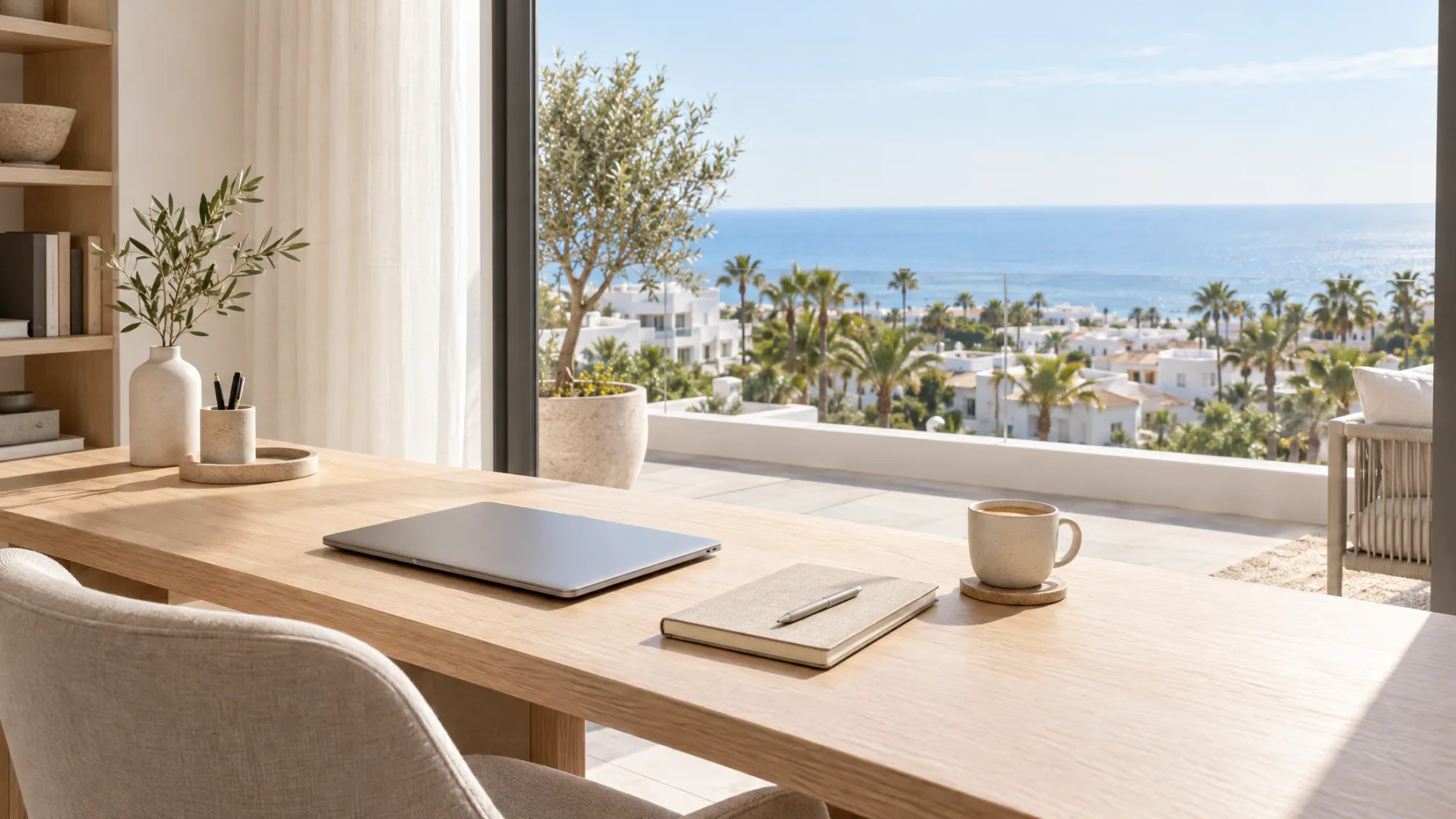
Move to Spain: Your Complete Guide to a New Life on the Costa del Sol

Coffee in the sunshine in February, the sea at the end of the street, dinner outside with friends at ten in the evening. For many people, the decision to move to Spain starts with a feeling on holiday: that life here is warmer, slower and more generous with its time. On the Costa del Sol, that feeling can become your everyday life.
We made this move ourselves, from Germany to Estepona, and applied for our NIE and residence ourselves: the appointments, the padrón, the first year of learning how a Spanish town works. Since 2019 we have worked with all the developers from Sotogrande to Marbella, and I look after every buyer personally. This guide brings together what matters when you move to Spain, in the order you need it: the life, the place, the route, the first steps, and the home where it all comes together.
Why move to Spain: the life that is waiting for you
Spain offers something that is rare in Europe: a high quality of life, a warm climate and a culture that puts people first. The reasons to come are different for everyone, but they tend to meet in the same place: more time outdoors, more time with others and more time for yourself.
The climate is the obvious start. On the Costa del Sol, winters are mild and bright, spring and autumn are long and golden, and summer is for the sea and late evenings. Life moves outside for most of the year: to the terrace, the promenade, the beach bar and the square in the old town. Children play outside until late, neighbours greet each other by name, and lunch is still an event rather than a sandwich at a desk.
Then there is the food, the culture and the landscape. Fresh fish from the harbour, fruit and vegetables from the market, tapas with friends. Festivals in every season, from Holy Week to the summer fairs. Mountains within half an hour of the beach, white villages in the hills, and the great cities of Andalusia, Seville, Granada, Córdoba and Ronda, within a day trip.
And for many, it is the pace. Spain is a modern country with excellent infrastructure, fast internet and good healthcare, but it has kept a sense of balance that many people miss at home. Whether you come to retire, to work remotely, to raise a family or simply to live better, the move to Spain is, above all, a move towards a different rhythm of life.
Where to start your new life: why the Costa del Sol and Estepona
The western Costa del Sol combines beaches, mountains and year-round towns, and Estepona sits at its heart. It is one of the few places in Europe where you can have the sea, the sun, a real Spanish town and an international community all at once.
Estepona has almost 80,000 residents, a restored old town full of flowers, 21 kilometres of coastline and a long seafront promenade. It lives all year, so the cafés, shops, doctors and schools are open in February as well as in August. According to the town hall, Estepona has repaid its inherited debt, has funded its own hospital, has almost completed a coastal path of more than 21 kilometres and is investing around €27 million in its 2026 budget, while property tax for registered households is falling. The population grew from around 67,000 in 2016 to almost 80,000 in 2025, which says a lot about how many people have chosen it as home.
The location makes the rest easy. Málaga airport is 84 kilometres away, with flights across Europe, and Gibraltar is 45 kilometres to the west. Marbella is half an hour up the coast, and Sotogrande, with its marina and polo, a short drive in the other direction.
The cost of settling in is concrete. On our own analysis, long-term rents in Estepona averaged €21 per square metre a month in August 2026, so an 80 m² apartment rents for around €1,680 a month. New developments were asking €5,145 per square metre on our survey of 18 September 2026, against €7,491 in our Marbella market area, and only 2.9% above the Resale index. For the same budget, you get more space in Estepona, in a town that feels like home from the first month.

Which route fits you: moving to Spain as an EU or non-EU citizen
The first question is your passport: EU citizens simply move and register, everyone else chooses a residence route. Once you know which group you belong to, the rest of the plan follows naturally.
EU, EEA and Swiss citizens: free to move
If you hold an EU, EEA or Swiss passport, you have the right to live in Spain. You do not need a visa, and after three months you register as a resident, showing that you work here, or that you have sufficient means and health cover with full protection in Spain. You receive a registration certificate and your NIE number, and from then on you live here like any other resident.
Everyone else: 90 days, then a residence permit
Citizens of the UK, the US, Canada, Australia and many other countries can stay up to 90 days in any 180-day period in the Schengen area without a visa, which is perfect for a first long visit to look at towns and homes. To live here, you need a residence route. The main options are set out in the next section, and the choice depends on one simple question: will you work while you live here, and if so, for whom?
For British movers, the post-Brexit details are covered in our guide to moving to Spain from the UK, and for Americans in our guide to moving to Spain from the USA. Both go through pensions, healthcare, driving and the questions that differ by country.
The residence routes when you move to Spain from outside the EU
Spain offers a residence route for almost every life plan: living on your own income, working remotely, working for a Spanish employer or starting a business. Two routes stand out for people moving to the Costa del Sol: the non-lucrative visa and the digital nomad visa.
| Route | For | Income in 2026 |
|---|---|---|
| Non-lucrative visa | Retirees, living on own means | €2,400 a month + €600 per family member |
| Digital nomad visa | Remote work for employers or clients abroad | around €2,849 a month |
| Work permit | A job with a Spanish employer | Set by the employment |
| Entrepreneur or highly qualified | Innovative business, senior professionals | Set by the route |

The non-lucrative visa is for people who support themselves without working in Spain, from pensions, savings, rent or investments. It is applied for at the Spanish consulate for your place of residence, starts with one year and is renewed for two years at a time. Our guide to the Spain non-lucrative visa covers the documents and steps, and our guide to how to retire in Spain adds pensions and healthcare.
The digital nomad visa is for remote workers employed by, or working for, companies based outside Spain. The company must have been active for at least a year, and you need at least three months of working relationship with it before you apply. Applied for from inside Spain, it gives a residence permit of up to three years. Our guide to the digital nomad visa sets out the income calculation and the tax side.
The golden visa, which linked residence to a property purchase, closed to new applications on 3 April 2025. The routes the Spanish government points to instead, for entrepreneurs and highly qualified professionals, are explained in our overview of the alternatives to the golden visa. Buying property in Spain remains open to everyone, with or without residence.
Preparing your documents before you move to Spain
Good preparation is the secret of a smooth move, and most of it can be done from home. The documents for a residence application are ordinary paperwork, but they need to be prepared in the right order.
- A passport valid for at least a year, with a copy of every page
- Proof of income or means: bank certificates, pension statements, employment or client contracts
- Health insurance with an insurer authorised in Spain, or an S1 form where it applies
- A criminal record certificate from each country you have lived in over the relevant period
- A medical certificate for routes that require one
- Birth and marriage certificates for family members moving with you
- School records for children, and vaccination records for pets
Documents issued abroad generally need an apostille under the Hague Convention and a sworn translation into Spanish. Criminal record and medical certificates have a limited useful life, so they are best obtained last, a few weeks before your appointment, while bank letters, pension statements and family certificates can be prepared well in advance.
Keep digital copies of everything in one folder, and bring the originals with you when you move. You will use many of them again in the first weeks, at the town hall, the bank and the police office where you collect your residence card.
Your first weeks in Spain: padrón, NIE, residence card and bank
The first weeks are about a handful of appointments, and after that Spain simply becomes home. The order below is the one that makes each step easier than the last.
- Register on the padrón at the town hall with your rental contract or deed. It confirms your address and opens the door to local services, schools and healthcare registration.
- Collect or confirm your NIE, the foreigner's identification number you need for almost everything.
- Apply for your residence card: the TIE within one month of arrival if you came on a visa, or the EU registration certificate if you are an EU citizen.
- Open a Spanish bank account for rent, utilities, taxes and direct debits.
- Get a Spanish phone number, which banks, doctors and schools will ask for.
- Register for healthcare with your insurer, or with the public system through an S1 or the convenio especial.
- Enrol the children in school and set up utilities in your own name.
The NIE deserves a special word, because it is the key that opens every other door: bank accounts, contracts, tax returns and property purchases all need it. Our guide to the NIE number in Spain explains how to get it, from a consulate abroad or in Spain, and how it relates to your residence card.
We registered on the padrón, applied for our NIE and completed our residence registration ourselves when we moved to Estepona, and the best advice we can give is simple: take them one at a time, in this order, and keep copies of everything. Within a few weeks, the paperwork is done and the life you came for can begin.
Working in Spain after the move
Whether you keep your job abroad, find work here or start your own business, Spain has a clear framework for each. The right route depends on your passport and on who pays you.
EU citizens can work in Spain freely, as employees or self-employed, on the same terms as Spaniards. For everyone else, the residence route decides: the digital nomad visa allows remote work for employers or clients abroad, with up to 20% of a freelancer's work for Spanish clients; a work permit is tied to a job with a Spanish employer; and the entrepreneur route is for an innovative business project approved in advance. The non-lucrative visa, by contrast, is designed for life without work in Spain.
If you work for yourself in Spain, you register as self-employed, an autónomo, with the tax office and social security, which also gives you access to the public health system. A local gestoría, an administrative agency, handles the registration and the quarterly returns for a modest monthly fee, and it is one of the best investments a newcomer can make.
For remote workers, the Costa del Sol is a pleasant place to work. A home office with good light, a terrace with a sea view for the coffee break and a reliable connection make a very good office; ask about fibre internet and the layout of the second bedroom when you compare developments. And because the time zone is the same as most of continental Europe, working hours with clients in Germany, France or the Netherlands stay exactly as they were, while the view from the window changes completely, from grey rooftops to palm trees and the sea.
Healthcare after you move to Spain
Spain has excellent healthcare, and there is a clear route into it for every kind of resident. Which route applies depends on your situation.
If you work in Spain as an employee or register as self-employed, you pay into Spanish social security and are covered by the public health system. If you come on the non-lucrative or digital nomad visa without Spanish social security, you show private health insurance with an insurer authorised in Spain, covering what the public system covers. Several Spanish insurers offer policies designed for residence applications.
If you receive the UK State Pension, an S1 form gives you access to Spanish public healthcare once it is registered with the Spanish social security office. And after a year of registration on the padrón, residents in Andalusia without other access can join the public system through the convenio especial, at €60 a month under 65 and €157 a month from 65, with medicines paid in full.
Private healthcare on the Costa del Sol is of a high standard, with modern clinics along the coast and English-speaking doctors, and public and private cover can be combined. According to the town hall, Estepona has funded its own hospital, which brings care even closer to home.
Tax after your move to Spain: plan it before you go
Living in Spain for more than 183 days a year makes you tax resident here, and a little planning makes that simple. A tax resident is taxed in Spain on worldwide income, and double taxation treaties decide which country taxes what, so income is not taxed twice.
For people who move to Spain to work, there is a special regime known as the Beckham law. Under Article 93 of the Personal Income Tax Act, someone who becomes tax resident because of a move can opt to pay 24% on employment income up to €600,000 for the year of arrival and the following five, provided they were not resident in Spain in the five years before. The election must be made within six months of the start of the activity, so it belongs in your plan from day one.
Americans keep filing US tax returns wherever they live, and British retirees will find that private pensions and the State Pension are taxed in Spain under the UK–Spain treaty, while government service pensions stay taxable in the UK. The country guides go into the details for each.
Family life: schools, children and a new language
Children settle in after a move to Spain faster than you might think, and the Costa del Sol offers a wide choice of schools. The outdoor life, the sea and the friendly culture make the transition easier.
Spanish state schools are free, and children who start young pick up the language quickly, becoming bilingual in a way that stays with them for life. Alongside them, the Costa del Sol has international schools teaching in English and other languages, including British schools across Málaga province and the German School in Málaga. The choice of school often shapes the choice of neighbourhood, so it is worth looking at both together.
For adults, learning Spanish opens every door, from the market to the town hall. Language schools, private teachers and language exchanges are easy to find, and even a little Spanish is met with warmth. Children's sports clubs, beach days, festivals and school friends quickly build a new social life for the whole family.
Driving, pets and the practical side of the move
The practical details of a move to Spain are easy once you know the rules for your country. Two questions come up for almost everyone: the car and the pets.
Driving. EU driving licences are valid in Spain. A UK licence can be used for six months after you become resident and can be exchanged for a Spanish one without a test. An American licence cannot be exchanged, so after six months of residence you take the Spanish theory and practical tests; an international driving permit is useful until then. In the centre of Estepona you can manage well without a car, because the old town, the promenade and the market are all on foot.
Pets. Dogs and cats travel with a microchip, a rabies vaccination at least 21 days before travel and a health certificate. From the UK this is the Animal Health Certificate, used within ten days for entry; from the US, a USDA-accredited vet issues the EU certificate, APHIS endorses it, and you enter Spain within ten days. Once here, a Spanish vet can issue an EU pet passport. The coast is very dog-friendly, with dog beaches and long walks along the coastal path.
Your belongings. You may need to bring less than you expect: Spanish homes, and new builds in particular, are often sold with fitted kitchens, wardrobes and air conditioning, and furniture suited to the climate is easy to buy locally. A few favourite things, family pictures and the kitchen knives you love, and the rest can wait until you know your new home.
Finding your home: rent first or buy new
Your home is the heart of your move to Spain, and there are two good ways to find it. Renting gets you here quickly, and buying gives you a home that is truly yours.
A rental is the fastest way to arrive, and it is often the address you register on the padrón in your first weeks. On our own analysis, long-term rents in Estepona averaged €21 per square metre a month in August 2026, so an 80 m² apartment costs around €1,680 a month.
Buying a New Build fits a move particularly well. Off-plan, the construction months run in parallel with your preparation: while the building rises, you prepare your documents, arrive, rent in the area you have chosen and settle in. When the keys arrive, you move into a home built to current standards, with modern insulation, air conditioning and energy efficiency, on the floor and with the view you chose from the plans. Payments during construction are protected by a bank guarantee or insurance in your name once the building licence is granted, and the law provides warranties of up to ten years after handover.
In Estepona, new homes cost little more than second-hand ones, only 2.9% above the Resale index in September 2026, and the town has the largest choice of new developments between Sotogrande and Marbella. Our complete guide to buying property in Spain covers the purchase step by step, and our guide to buying off-plan in Spain explains the protections. The new developments in Estepona show what is available today.
New developments in Estepona






Your move to Spain: a timeline from first idea to first year
A move to Spain can take a few months to prepare, and the first year is when it starts to feel completely like home. This is how the journey can look for someone moving from outside the EU:
- Months 1–2 Visit the coast, choose your town and neighbourhood, decide on your residence route.
- Months 2–4 Prepare documents, arrange health insurance, meet a tax adviser.
- Months 4–6 Consulate or residence application, decision, travel plans.
- Arrival Padrón, residence card, bank account, phone, schools.
- First year Settling in, Spanish lessons, new friends, and your own home found or being built.
For EU citizens the timeline is shorter, because there is no visa to wait for: you choose your town, arrive and register. Either way, starting early leaves time to enjoy the preparation, and a few weeks on the coast before the move make every later decision easier.
Settling in: making Spain your home
The first year is the one where Spain turns from a destination into home. A few habits make the difference between living in Spain and truly arriving.
Learn the rhythm of the day: a late lunch, a quiet afternoon, a lively evening. Shop at the market and the local bakery, and within weeks you will be greeted by name. Say yes to invitations, join a club, a walking group or a volunteer project, and take Spanish lessons, even if you start slowly. The international community on the coast is warm and welcoming, and the Spanish community even more so once you make the first step.
And give yourself time. The paperwork is done in a few weeks, the rest takes a season or two: finding your favourite beach, your café, your doctor and your friends. By the second summer, most of what felt new has become simply part of life, and the Mediterranean outside your window has become your view, not your holiday.
Move to Spain: the life you want first, then the place
Start with the life you want, then the place, then the route. Picture an ordinary week in your new life: where you have your coffee, how you work or spend your days, where the children go to school, who you see at the weekend. Then come to the Costa del Sol for a few weeks and see how that week feels here.
From there, the path is clear: the residence route that fits you, the documents in the right order, a conversation with a tax adviser and the first appointments after arrival. If you move to Spain and choose Estepona, you find a real town, a beautiful coast and the largest choice of new homes on this part of the coast. I would be delighted to show it to you.
Frequently asked questions
Can I just move to Spain?
If you are an EU citizen, yes: you can move to Spain without a visa and register as a resident after three months. From outside the EU you need a residence route, such as the non-lucrative visa if you live on your own income or the digital nomad visa if you work remotely.
Which visa do I need to move to Spain?
To move to Spain without working here, the non-lucrative visa is the route, at €2,400 a month in 2026. For remote work there is the digital nomad visa, at around €2,849 a month. There are also routes for employees with a Spanish job, entrepreneurs and highly qualified professionals.
How long can I stay in Spain without a visa?
Citizens of the UK, the US and many other countries can stay up to 90 days in any 180-day period in the Schengen area without a visa. A longer stay needs a residence permit.
What do I need to do first when I arrive in Spain?
Register on the padrón at the town hall, apply for your residence card within a month if you came on a visa, or register as an EU resident, and open a Spanish bank account. Your NIE number is the key to everything else.
Do I need health insurance to live in Spain?
Yes. Residence routes require health cover, usually private insurance with an insurer authorised in Spain. UK State Pension recipients can use an S1 form, and residents in Andalusia can later join the public system through the convenio especial.
Will I pay tax in Spain after I move?
If you spend more than 183 days a year in Spain, you are tax resident here and taxed on worldwide income, with double taxation treaties preventing tax twice. Inbound workers can opt for the Beckham regime at 24% up to €600,000.
Can I drive in Spain with my licence?
EU licences are valid in Spain. A UK licence works for six months after you become resident and can be exchanged without a test. A US licence cannot be exchanged, so after six months you take the Spanish tests.
Where should I live when I move to Spain?
That depends on your life. On the Costa del Sol, Estepona combines a year-round town of almost 80,000 residents, 21 kilometres of coast and its own hospital with the largest choice of new homes between Sotogrande and Marbella.
Should I rent or buy when I move to Spain?
Both work. Buying off-plan fits a move particularly well: while your new home is being built, you rent in your chosen area, settle in and then move into a home designed for the way you live here.
Can I bring my pets?
Yes. Dogs and cats need a microchip, a rabies vaccination at least 21 days before travel and a health certificate, and they enter Spain within ten days of the certificate being issued or endorsed.
Sources & official links
- BOE – Royal Decree 1155/2024, Immigration Regulation (checked 21.09.2026)
- BOE – Royal Decree 240/2007, residence of EU citizens (checked 20.09.2026)
- BOE – Law 14/2013, international teleworking (checked 21.09.2026)
- Plataforma One (Spanish government) – Abolition of the investor visa (checked 20.09.2026)
- GOV.UK – Living in Spain (checked 19.09.2026)
- Junta de Andalucía – Convenio especial for healthcare (checked 19.09.2026)
- Agencia Tributaria – Form 720, declaration of assets abroad (checked 19.09.2026)
- GOV.UK – Taking your pet abroad (checked 19.09.2026)
- USDA APHIS – Pet travel from the United States to Spain (checked 20.09.2026)
- Ayuntamiento de Estepona – 2026 budget (checked 21.09.2026)